Better Homes

A homeowner's comprehensive pricing guide for water filtration systems

What is the true cost of a whole home water filter?

A useful price starts with the quality your water, your home, and the treatment it actually needs.

This guide shows how to compare quotes, why installers charge different prices and how to pick the right system based on your unique needs.

At the end of this guide there is also a free estimate calculator tool you can use to build your own estimate.

A quick starting point for the average systemthere is no one shoe fits all water filtration system as everything is customized based on your needs.

But the average system can go between $2,600 to $6,000 depending on the size of your home and quality of your water.
Complete Home System Package & Install
$3,250
Better Homes whole-home filtration, softening, and drinking water systems

The average all rounder system for most homeowners

What it does

SoftenFilterPurify drinking water

What it fixes

White buildupPool like smellUnusual taste or cloudiness
01 / The quote

Making sense of the price

Why can two systems look alike and cost so differently?

When you compare whole-home water filters online, you see the same looking tanks and valves but all priced differently.

This can be broken down into three layers:

Inside the systemwhich is also mostly out of sight: media, treatment stages, valve, capacity, and any drinking water RO.
Your home installationwhat kind of installation service is needed: plumbing access, a drain, electrical needs, labor, and service after installation.
Retailer markuphow companies markup their products: distribution, advertising, sales commissions, and financing can be reflected in a quote.

For example, one tank might hold softening resin.

Another might contain carbon for taste and odor.

A well water setup may add an air injection stage and a separate tank.

The equipment also has to deliver enough water when several fixtures run at once.

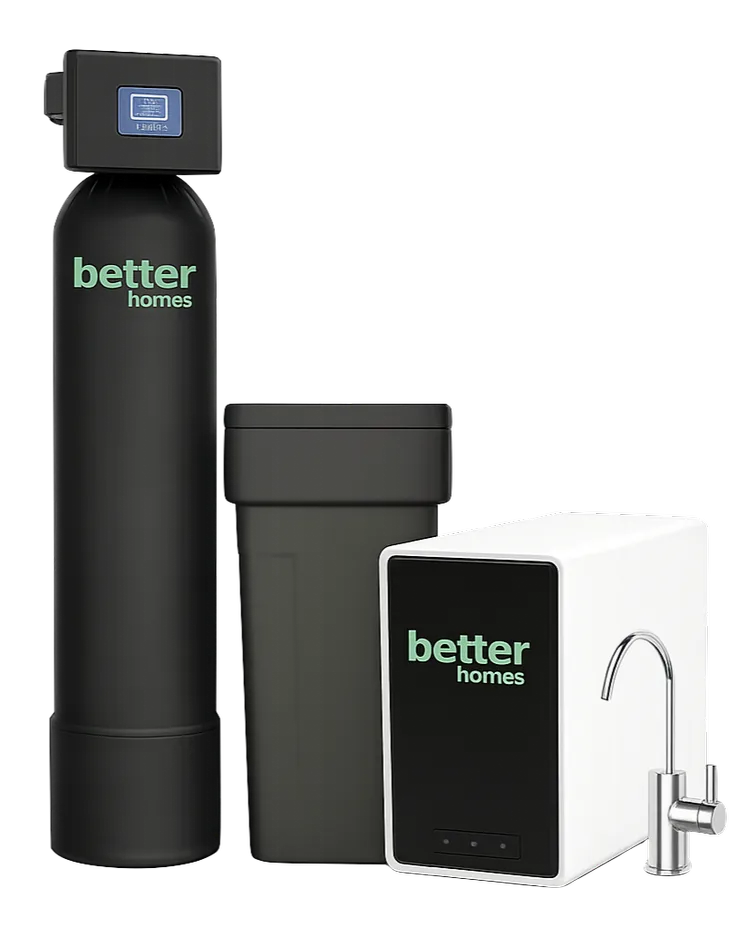
That is why a photo of a black tank tells you very little about the value of the quote.

On top of that, not only are systems priced differently due to features, but every water installation company has massively different fees for the exact same product.

This is largely to do with the transit process from manufacturer, dealer, retail, sales commissions and other operational costs.

For example, Better Homes is a direct to manufacturer distributor,

this allows us to sell and install the same high quality systems that sell on the market for $12,000 for just $4,900.

Because there is no one shoe fits all price since everything is customized to your needs,

how are you supposed to decide on what product or company to go for?

Thus, we leveraged our connection to manufacturers in order to find out what the fair market practice for water systems in the United States should cost.

We took that research and created a pricing list in this guide so you can make better informed decision on what the best price to quality ratio on a whole home water filter system is.

02 / Your water

Start at the source

What’s in your water?

Before you compare equipment, get to know the water it will treat.

Where it comes from is the first clue (city or well), then its about the water characteristics.

There are only a handful of systems out there that will tackle pretty much most water issues a home owner would have.

This cheat sheet will help you determine what you're dealing with.

City water

Look at your water report.

Your utility’s annual report is a useful starting point.

Take notes of what you see at home: spots on glasses, buildup around faucets, or a taste you don’t enjoy.

Find your utility report ↗
Well water

Start with a well test.

EPA recommends testing private wells annually for bacteria, nitrates, dissolved solids, and pH.

Well-testing guidance ↗

White buildup

Scale on faucets and spots on dishes can point to hard water.

Pool like smell

Chlorine may explain a familiar pool like taste or odor. This can dry out your skin and hair.

Rotten-egg smell

A sulfur or rotten egg smell can be caused by hydrogen sulfide or bacterial activity.

This leads to awful smells, headaches, and nausea especially in well water.

Colored stains

Red-orange (iron), blue-green (copper), brown-black (manganese) can be clues to metals or plumbing issues.

This can cause bad tasting water, stains and gastrointestinal illnesses.

Unusual taste or cloudiness

Metallic, salty taste, or visible cloudy, dirty particles may contain dissolved solids (iron, zinc, sulphates, chlorides)

This can cause plumbing buildup, gastrointestinal illnesses and foul odors.

Water that looks clear

Appearance alone cannot tell you everything about your water.

Almost every home would need some sort of filtration system to have full proof care free water.

These are clues, not a true diagnosis. Water treatment system should match confirmed water conditions.

If you need a free water test you can reach out to us here: Better Homes.

03 / Your home

Size the solution

What your home needs

Bathrooms are a useful starting point, but a system must also keep up when water is used in several places at once.

Think about a busy morning: two showers running while the washing machine fills.

Your system needs to handle that demand comfortably.

Household size, bathroom count, and the way you use water help narrow down the right setup.

Bathrooms

Count the number of bathrooms and bedrooms and how many times showers typically run at once.

People at home

More people usually means more water used over the day. This helps size the system.

Installation space

Where the water enters your home, available space, and access to plumbing help define the work.

What size fits

HouseholdBathroomsTypical starting point
1–3 people1–2Small System (9×48-inch tank)
3–5 people2–3Standard System (10×54-inch tank), the same tank size as Dual Tank City and the salt-free conditioner
5+ people3+A larger setup. Tank size will depend on the harshness of your water

Hardness changes the size too. A softener’s workload grows with how many people use water and how hard that water is. Very hard water in a busy home needs a bigger tank, or a smaller one that cleans itself (regenerates) more often and uses more salt.

What can add to the install

These are listed separately in the estimator, so you only pay for the ones your home needs.

A long pipe run (+$830)Trenching when the pipe has to run more than 15 feet underground to reach the system.
Removing an old system (+$200)An existing softener or filter is taken out and disposed of.
A new countertop hole (+$100)The drinking-water faucet usually needs its own hole. Drilling one, especially in stone, is extra work.
No new hole (+$100)A valve sends RO water through your existing kitchen faucet instead of a separate one.
Fridge water line (+$150)RO water can feed your refrigerator, if your fridge and water pressure allow it.
A second drinking-water sink (+$400)Another RO system for a second sink, installed with your system.
Taking it with you (+$1,500)Uninstalling the system and reinstalling it at your new home.

Home situations that change the type of system

A septic systemSalt-based softeners send salty rinse water down the drain. Some homeowners on septic prefer a salt-free system.
Local rules on softenersSome areas restrict salt-based softeners. A salt-free system avoids that.
A low-sodium dietSoftened water adds a small amount of sodium. Drinking-water RO removes it, or a salt-free system avoids adding it.
Renting or moving soonA smaller setup, or RO only, may make more sense than a whole-home system. Systems can also be moved for a fee.

What the installer will look for

A drain nearbySofteners and RO systems send rinse water to a drain.
A power outletThe control valve, and UV if you add it, need electricity.
Room for the tanksFloor space near where water enters the home. Whole-home RO also needs room for a 300-gallon storage tank.
Protection from freezingTanks and lines need to be indoors or protected from frost.

Living with it

The install price is upfront. These are the ongoing parts; ask Better Homes for current replacement costs.

Softener saltRefill the brine tank, typically every month or two.
Filter cartridgesReplace on a schedule, often every 6 to 12 months.
Drinking-water ROPre-filters about once a year; the membrane every few years.
UVReplace the bulb about once a year.
Peroxide injectionRefill the peroxide as it runs low.
04 / The treatment

Choosing the solution

What fair market pricing looks like

Water treatment comes down to three jobs, plus one extra for drinking water.

Each system below shows the jobs it does, the water problems it fixes and the estimated price.

These prices may vary across installers, but based on our product manufacturing research

this is what the fair market price for a system + install should look like.

Soften

FixesHard water: dissolved calcium and magnesium that leave scale behind.

The systemA softener, a resin tank that uses salt, removes the hardness. A salt-free conditioner keeps scale from sticking without removing it.

Filter

FixesChlorine or chloramine, the disinfectants cities add, along with taste, odor, and many chemicals.

The systemA carbon tank or cartridge. Big-city water often uses chloramine, which calls for catalytic carbon.

Fix well water

FixesIron, manganese, sulfur, sediment, and sometimes bacteria.

The systemEquipment that turns iron and sulfur into particles a filter can catch, using air injection or peroxide injection, plus UV for bacteria.

Purify drinking water

FixesNearly everything dissolved in water, including lead, nitrates, and salt.

The systemReverse osmosis (RO) under the kitchen sink, feeding its own faucet. Most packages include it. Whole-home RO does this for every tap.

The systemPriceTreatment
RO onlyPurify drinking waterPrice this system ↓
$1,000Unusual taste or cloudinessWater that looks clearPurified drinking water at one kitchen sink. Water everywhere else in the house stays untreated.
Salt-free cartridge system with ROSoftenFilterPurify drinking waterPrice this system ↓
$2,500White buildupPool-like smellUnusual taste or cloudinessThree filter cartridges with carbon, plus drinking-water RO. Scale control comes from the version with the SP3 cartridge; it prevents scale rather than removing hardness. Cartridges cost less up front but need regular replacement.
Salt-free conditioner with ROSoftenPurify drinking waterPrice this system ↓
$2,850White buildupUnusual taste or cloudinessA tank of SP3 media prevents scale without salt or a drain. It doesn’t remove hardness, so expect fewer spots, not zero. It has no carbon; a carbon tank can be added for $1,000.
Small or Standard SystemSoftenFilterPurify drinking waterPrice this system ↓
$2,650–$2,850White buildupPool-like smellUnusual taste or cloudinessSoftening and carbon share one tank (a “mixed bed”), plus drinking-water RO. Small (9×48) or Standard (10×54) depends mostly on household size.
Dual Tank CitySoftenFilterPurify drinking waterPrice this system ↓
$3,950White buildupPool-like smellUnusual taste or cloudinessSoftening and carbon each get their own tank, so filtering is stronger and lasts longer. Includes drinking-water RO.
Well-water systemSoftenFilterFix well waterPurify drinking waterPrice this system ↓
$4,450–$6,000Rotten-egg smellColored stainsWhite buildupUnusual taste or cloudinessAdds the well-water job: turning iron, manganese, and sulfur into particles and filtering them out. Air injection with Katalox ($4,450) or the stronger peroxide injection ($6,000), both with drinking-water RO.
Whole-home reverse osmosisSoftenFilterFix well waterPurify drinking waterPrice this system ↓
$11,400–$13,400White buildupPool-like smellRotten-egg smellColored stainsUnusual taste or cloudinessWater that looks clearRO for every tap, with a 2,000 GPD membrane, 300-gallon storage tank, and pumps. The well version ($13,400) adds iron and sulfur treatment.

Prices are Better Homes’ listed package prices. Optional filters, extra plumbing work, and upgrades are itemized separately in the estimator.

Where most homes land: city homes usually end up with the Standard System, or Dual Tank City for stronger filtering. Well homes end up with one of the two well systems. Everything else is a refinement.

Jargon decoder11 terms
Softener (resin)A tank of resin beads that trades hardness minerals for sodium. Uses salt and a drain.
Mixed bedSoftening resin and carbon combined in one tank, as in the Small and Standard Systems.
Carbon / catalytic carbonFilter media that removes chlorine, taste, and odor. Catalytic carbon also handles chloramine.
ChloramineChlorine combined with ammonia. Many large cities use it because it lasts longer in the pipes; ordinary carbon struggles with it.
Salt-free conditioner (SP3)Media that changes hardness minerals so they don’t stick as scale. No salt and no drain, but the minerals stay in the water.
Air injection (AIO) + KataloxAir turns iron, manganese, and sulfur into particles; Katalox is the filter media that catches them.
Peroxide (HP) injectionA small pump doses hydrogen peroxide for heavier iron or sulfur problems.
UVUltraviolet light that disinfects water as it flows past. Used for bacteria, mostly in well water.
Reverse osmosis (RO)A very fine membrane that removes nearly everything dissolved.
Tankless ROAn RO system without a storage tank: more compact, making water on demand.
GPDGallons per day: how much water a membrane can produce.

05 / Your estimate

Build your own estimate.

Now that you've learned all the essentials, its time to build your own estimate.

Choose your package and extras. See the complete price, download a PDF, or send your selections to Better Homes for a final quote.

Your estimate starts here
Estimated total $0

Step 1

Tell us about your home.

These details help Better Homes review your selections. You can leave anything you’re unsure about blank.

Your water source

Still not sure what you need or have additional questions regarding whole home water filtration pricing?

You can submit any questions you may have or hop on a free consultation call with our team:

(850) 680-6598